Workplace mental health is no longer a “nice-to-have” initiative. It is a strategic priority.
Burnout, stress, disengagement, and emotional fatigue are quietly impacting productivity, retention, and overall business performance. Traditional support systems like annual engagement surveys or employee assistance programs (EAPs) often fail to provide timely, personalized intervention.
This is where AI workplace mental health solutions are changing the game.
Artificial Intelligence is shifting workplace mental health support from reactive and generalized to proactive, personalized, and data-driven. Organizations are now using AI to detect early warning signs, deliver continuous support, and empower employees in ways that were not possible before.
Let’s explore how.
The Problem with Traditional Workplace Mental Health Support
For years, companies relied on:
- Annual engagement surveys
- One-size-fits-all wellness workshops
- Reactive EAP counseling services
- Manager-led check-ins
While these initiatives show good intent, they often miss three critical gaps:
- Delayed insights – Feedback collected once or twice a year is too late.
- Low utilization rates – Many employees never use EAP programs.
- Lack of personalization – Generic solutions don’t address individual needs.
Mental health challenges rarely appear overnight. Burnout builds slowly. Stress compounds quietly. Disengagement grows in silence.
Without real-time insight, leaders are left guessing.
How AI Workplace Mental Health Solutions Change the Approach
AI transforms mental health support in five powerful ways:
1. Real-Time Sentiment and Behavioral Insights
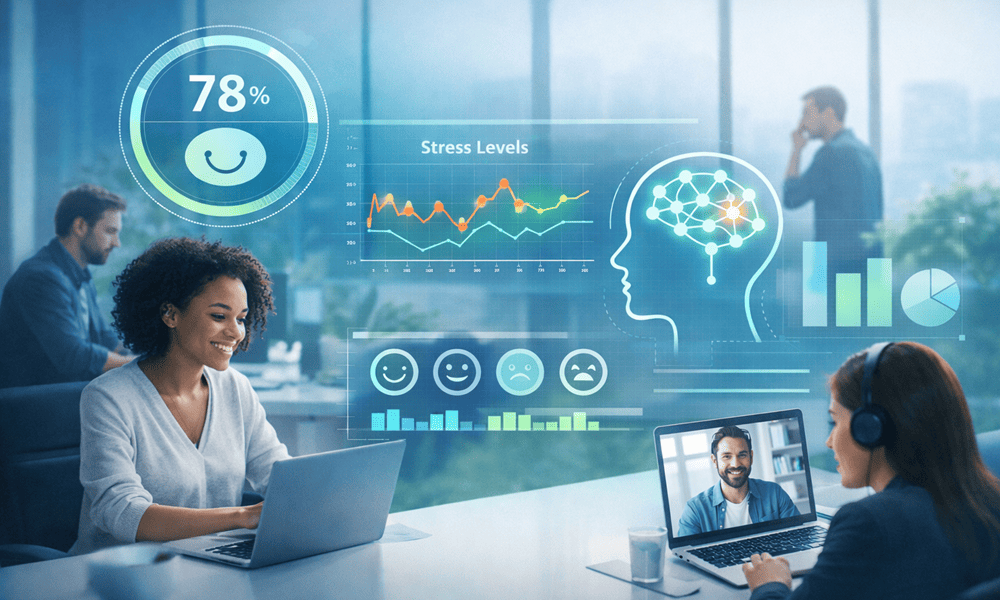
Modern corporate mental health technology can analyze employee sentiment continuously through anonymous pulse surveys, communication patterns, and engagement signals.
Instead of waiting for annual feedback, organizations gain:
- Real-time workforce mood tracking
- Early burnout indicators
- Engagement trend analysis
- Department-level wellbeing patterns
This allows HR leaders to intervene before issues escalate.
2. Proactive Burnout Detection
Burnout is one of the most expensive workforce risks. It leads to absenteeism, turnover, low productivity, and healthcare costs.
AI-powered systems identify patterns such as:
- Sudden drops in engagement
- Changes in work rhythm
- Increased stress indicators
- Emotional tone shifts in feedback
Rather than reacting to resignations, companies can act early.
Proactive prevention is far more cost-effective than damage control.
3. Personalized AI Mental Health Coach Support
One of the biggest breakthroughs is the rise of the AI wellbeing coach.
Unlike static wellness portals, AI coaching platforms provide:
- 24/7 confidential support
- Personalized coping strategies
- Guided micro-interventions
- Emotional intelligence development exercises
- Stress management tools tailored to individual needs
Employees don’t have to wait weeks for appointments. They can access digital mental health tools instantly, in moments of need.
For many workers, especially in high-pressure roles, immediate and private support removes stigma barriers.
4. Scalable Support Across Global Workforces
Traditional mental health programs struggle to scale across:
- Remote teams
- Hybrid work models
- Multiple time zones
- Multilingual environments
AI for employee wellbeing solves this scalability problem.
AI systems operate continuously, providing consistent support regardless of location. Whether employees work in offices, on-site environments, or remotely, they receive equal access to mental health resources.
This is especially critical as remote and distributed teams become the norm.
5. Data-Driven Decision Making for HR Leaders
AI workplace mental health platforms generate actionable analytics.
HR leaders can track:
- Burnout risk levels
- Engagement scores
- Emotional resilience trends
- Program utilization rates
- Correlation between wellbeing and performance
Instead of guessing what employees need, leaders make informed decisions backed by data.
This shifts workplace mental health from a “soft initiative” to a measurable business strategy.
The Business Impact of AI Mental Health Support
When implemented strategically, AI mental health support delivers measurable business outcomes.
Increased Productivity
Employees who feel supported are more focused, creative, and collaborative. Reduced stress leads to improved cognitive performance.
Lower Absenteeism
Early intervention reduces stress-related sick days and presenteeism.
Higher Retention Rates
Burnout is a leading cause of employee turnover. AI-driven early detection improves retention by addressing problems before employees disengage completely.
Stronger Leadership Development
AI tools can also enhance emotional intelligence training, helping managers develop better communication and empathy skills.
Improved Organizational Culture
When employees see that mental wellbeing is actively monitored and supported, trust increases.
AI and Emotional Intelligence at Scale
One overlooked advantage of AI workplace mental health solutions is emotional intelligence development.
AI systems can:
- Provide reflective prompts
- Offer communication feedback
- Guide conflict-resolution techniques
- Suggest stress de-escalation strategies
This builds emotionally intelligent teams without requiring expensive large-scale training programs.
Emotional intelligence is strongly linked to leadership effectiveness, team collaboration, and performance outcomes. AI makes it scalable.
Addressing Privacy and Ethical Considerations
Adopting AI for employee wellbeing requires responsible implementation.
Best practices include:
- Ensuring anonymity in sentiment analysis
- Transparent communication about data usage
- Clear consent protocols
- Strict data protection standards
Employees must trust the system. When transparency is prioritized, adoption rates increase significantly.
Ethical AI builds confidence rather than fear.
The Future of Corporate Mental Health Technology
The next generation of workplace mental health solutions will likely include:
- Predictive burnout modeling
- AI-driven personalized wellbeing journeys
- Integrated performance and wellbeing dashboards
- Real-time leadership alerts
- Adaptive resilience training
As organizations compete for top talent, mental health support will become a differentiator.
Companies that proactively invest in AI-powered solutions will build stronger, more resilient workforces.
Why AI Is Not Replacing Human Support
It’s important to clarify: AI is not replacing therapists or human coaches.
Instead, AI complements human support by:
- Handling early-stage stress detection
- Providing immediate assistance
- Reducing barriers to access
- Scaling basic interventions
Human professionals remain essential for complex cases. AI simply expands capacity and accessibility.
Think of AI as the first line of support—always available, always responsive.
Final Thoughts: From Reactive to Proactive Wellbeing
Workplace mental health challenges are not disappearing. In fact, they are intensifying as work becomes more demanding and digitally connected.
Organizations can no longer rely on outdated, reactive systems.
AI workplace mental health solutions represent a shift from:
- Periodic feedback → continuous insight
- Generic programs → personalized support
- Crisis response → early prevention
- Intuition → data-driven decisions
By integrating AI mental health support into corporate strategy, companies create healthier environments where employees can perform at their best.
And in today’s competitive landscape, that is not just good for people—it is good for business.