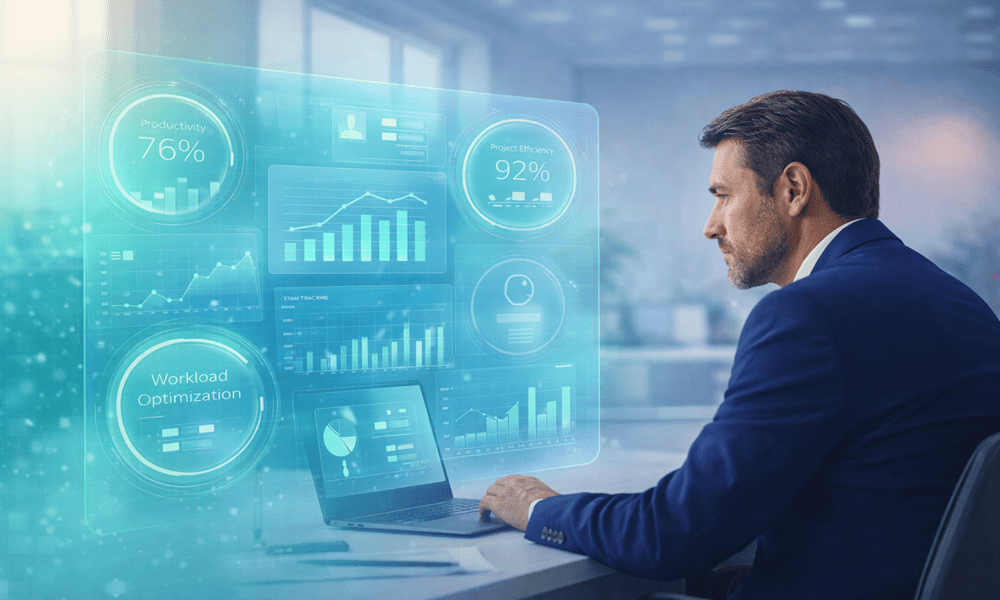
Modern enterprises run on data. Yet when it comes to workforce output, many leadership teams still rely on outdated reports and delayed reviews. AI employee productivity tracking changes that by providing continuous, actionable insights into how work actually gets done.
For corporate leaders, this isn’t about micromanagement. It’s about visibility, efficiency, and long-term performance stability. When implemented responsibly, AI employee productivity tracking helps organizations improve results while supporting employee wellbeing.
What Is AI Employee Productivity Tracking?
AI employee productivity tracking uses machine learning and behavioral analytics to measure workforce output across systems and workflows. Unlike basic time-tracking tools, modern AI workforce productivity tools analyze task cycles, collaboration data, workload patterns, and performance trends.
A sophisticated AI performance monitoring system integrates with HR software, project management platforms, and communication tools. It processes large volumes of data in real time to highlight patterns that human managers often miss.
Instead of asking, “How many hours were worked?” AI employee productivity tracking asks, “How effectively are resources being used?”
Why Enterprises Are Replacing Traditional Methods
Manual reviews and quarterly performance reports often create blind spots. By the time a productivity issue appears in a report, the business impact has already occurred.
Today’s productivity analytics software offers continuous performance visibility. This allows leadership to act early rather than react late.
According to Deloitte’s workforce studies, organizations using advanced analytics for workforce management see measurable gains in efficiency and engagement. While exact numbers vary by industry, the broader trend is clear: real-time insights outperform static reports.
When integrated with AI-driven performance management, productivity data becomes part of a continuous improvement cycle rather than a once-a-year evaluation.
How AI Employee Productivity Tracking Works
AI employee productivity tracking collects structured data from multiple systems—task managers, collaboration platforms, CRM tools, and HR databases. The AI engine then evaluates this data to detect trends such as bottlenecks, workload imbalance, and task delays.
With real-time employee performance tracking, leaders can identify workflow inefficiencies before they escalate into missed deadlines or burnout.
For example, if a department consistently works extended hours but output remains flat, the AI may flag capacity strain. That’s where AI workload optimization becomes critical.
Instead of increasing pressure, leaders can redistribute tasks, adjust timelines, or increase support.
Key Capabilities of AI Workforce Productivity Tools
Modern AI workforce productivity tools offer a wide range of functions, but most enterprise-grade systems share a few core capabilities:
- Continuous performance dashboards
- Automated performance reports
- Predictive trend forecasting
- Workload balancing recommendations
These features are typically part of a larger enterprise productivity platform that centralizes workforce insights.
Unlike traditional tools, AI employee productivity tracking doesn’t just measure output—it helps improve it.
AI Workload Optimization and Burnout Prevention
Burnout is expensive. Gallup research shows disengaged employees cost businesses billions annually in lost productivity. AI employee productivity tracking helps prevent this by identifying overload patterns early.
When performance data connects to employee performance optimization strategies, leadership can shift from reactive problem-solving to proactive planning.
Forward-thinking companies align productivity systems with their broader workplace wellbeing platform to ensure performance goals don’t undermine employee health.
This integrated approach builds trust while maintaining accountability.
AI Coaching as a Productivity Multiplier
Some AI systems now move beyond monitoring and into guidance. By combining productivity metrics with behavioral data, platforms can provide targeted suggestions.
When integrated with AI coaching for productivity, employees receive insights such as time allocation adjustments, meeting load recommendations, or task-prioritization tips.
This shift transforms AI employee productivity tracking from oversight into support.
Organizations that combine coaching with analytics often see stronger adoption and better long-term engagement.
Ethical Considerations in AI Performance Monitoring
AI employee productivity tracking must be implemented transparently. Without clear communication, employees may view monitoring tools as intrusive.
Responsible leaders focus on:
- Data transparency
- Aggregated reporting where possible
- Clear policy documentation
- Alignment with compliance standards
When positioned as part of broader AI-powered HR solutions, productivity tracking is seen as infrastructure—not surveillance.
Trust is the foundation of sustainable performance management.
Business Impact of AI Employee Productivity Tracking
Organizations adopting AI employee productivity tracking typically report improvements in efficiency, decision-making speed, and output consistency.
When combined with AI performance management tools, leaders gain the ability to connect productivity metrics directly to business KPIs.
Here’s how AI tracking compares to traditional methods:
| Feature | Traditional Tracking | AI Employee Productivity Tracking |
| Data Collection | Periodic | Continuous |
| Insight Type | Descriptive | Predictive & Prescriptive |
| Burnout Detection | Delayed | Early Warning Signals |
| Reporting Effort | Manual | Automated |
| Decision Support | Limited | Data-Driven Recommendations |
This level of intelligence supports broader goals like operational efficiency with AI, especially in large enterprises managing distributed teams.
Industry Applications
In technology companies, AI employee productivity tracking helps manage sprint cycles and distributed teams. In healthcare administration, it improves workflow coordination. Financial institutions use it to monitor compliance-related productivity.
Across industries, one theme remains consistent: AI employee productivity tracking enhances clarity in complex operational environments.
When performance data feeds into AI for corporate wellness initiatives, organizations see improved morale alongside measurable output gains.
Implementation Strategy for Enterprise Leaders
Rolling out AI employee productivity tracking requires more than purchasing software. It demands structured planning and executive alignment.
Leaders should focus on:
- Defining measurable productivity goals
- Selecting scalable AI workforce productivity tools
- Establishing governance policies
- Training managers to interpret data responsibly
By embedding these tools into enterprise systems, organizations build resilience and adaptability.
The Strategic Role of Enterprise Productivity Platforms
An advanced enterprise productivity platform integrates performance tracking, workload analytics, and HR data into a unified ecosystem.
This integration enables leadership to:
- Forecast staffing needs
- Identify high-performing teams
- Detect workflow inefficiencies
- Improve cross-department coordination
When aligned with structured performance frameworks, AI employee productivity tracking becomes a strategic asset—not just an operational tool.
Final Thoughts: Balancing Performance and People
AI employee productivity tracking is no longer optional for large enterprises seeking competitive advantage. It offers measurable gains in output, faster decision-making, and improved operational visibility.
However, the technology must be deployed thoughtfully. Productivity systems should empower employees, not pressure them.
Corporate leaders who combine analytics, ethical oversight, and wellbeing alignment will see the strongest returns. In 2026 and beyond, sustainable performance depends on data-backed clarity—and AI employee productivity tracking provides exactly that.