
Employee retention has become one of the biggest concerns for modern organizations. Skilled professionals have more job options than ever, and workplace expectations have changed. Employees now look for supportive environments, meaningful work, and companies that care about their wellbeing.
Traditional HR approaches often struggle to keep up with these expectations. Annual surveys and reactive policies rarely provide enough insight into what employees actually need.
This is where AI for talent retention and wellbeing is making a measurable difference. Artificial intelligence helps organizations understand employee sentiment, identify retention risks early, and build healthier workplaces.
In this article, we’ll explore how companies are using AI to improve employee wellbeing, reduce turnover, and create workplaces where people want to stay.
Why Talent Retention Has Become a Strategic Priority
Employee turnover is expensive. According to a report by the Society for Human Resource Management (SHRM), replacing an employee can cost six to nine months of that employee’s salary.
But the financial cost is only part of the problem. High turnover also affects:
- team stability
- knowledge continuity
- customer relationships
- workplace morale
Many organizations now recognize that retention and wellbeing are closely connected. Employees who feel supported and valued are more likely to remain with their employers.
This is why many companies are investing in AI-driven employee engagement initiatives that help HR leaders understand what employees need to stay motivated and satisfied.
What Is AI for Talent Retention and Wellbeing?
AI for talent retention and wellbeing refers to the use of artificial intelligence to monitor workforce sentiment, analyze employee behavior patterns, and support HR strategies designed to keep employees engaged.
Instead of relying only on exit interviews or yearly engagement surveys, AI systems analyze multiple signals across the employee experience.
These signals may include:
- feedback from internal surveys
- workload and productivity patterns
- collaboration data across teams
- participation in wellbeing programs
Using these inputs, organizations can generate workforce satisfaction analytics that show where employees are thriving and where support may be needed.
Many organizations integrate these insights with employee wellbeing software, which helps HR teams track engagement, wellbeing trends, and cultural signals across the company.
The Role of AI in Predicting Employee Turnover
One of the most powerful capabilities of AI for talent retention and wellbeing is the ability to detect early warning signs of employee turnover.
Traditional HR models often identify turnover risk only after employees begin looking for new jobs. By then, it is often too late to intervene.
With predictive turnover analytics, companies can analyze patterns such as declining engagement, changes in work behavior, or feedback trends that indicate dissatisfaction.
For example, an AI model may detect that employees in a certain department are experiencing increased workloads and reduced engagement scores. These signals can suggest a higher risk of resignations.
This insight allows HR leaders to take proactive action through targeted Employee retention strategies before employees decide to leave.
AI Employee Retention Tools in Modern HR Platforms
Modern HR technology platforms increasingly include AI employee retention tools that provide real-time workforce insights.
These tools help HR teams monitor employee satisfaction, engagement, and wellbeing without waiting for quarterly reports.
Common capabilities include:
- sentiment analysis from employee surveys
- engagement score tracking
- burnout risk detection
- predictive turnover alerts
These insights allow organizations to respond quickly when teams experience high stress or declining engagement.
Many companies combine these systems with AI-powered HR automation to streamline HR workflows and reduce administrative workload, allowing HR professionals to focus more on people rather than processes.
Monitoring Employee Engagement with AI
Employee engagement remains one of the strongest predictors of retention. However, measuring engagement accurately has always been challenging.
This is where AI engagement monitoring helps organizations gain deeper visibility into workforce sentiment.
AI systems can analyze patterns in employee communication, survey responses, and behavioral indicators to detect shifts in engagement levels.
For example, companies using AI culture analytics may identify:
- departments with declining morale
- teams experiencing communication breakdowns
- leadership changes affecting employee sentiment
These insights provide HR leaders with real-time visibility into workplace culture.
Many organizations use these insights alongside Workplace culture analytics to better understand how leadership practices and team dynamics influence employee satisfaction.
Workforce Satisfaction Analytics: Turning Data into Retention Insights
Data alone does not improve retention. The real value comes from translating data into practical workplace improvements.
This is where workforce satisfaction analytics becomes important.
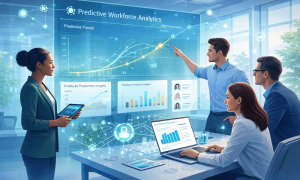
Organizations often use AI dashboards that show trends in employee wellbeing, engagement, and retention risk.
Below is an example of how companies interpret workforce satisfaction data.
| Workforce Indicator | Insight for HR Leaders | Possible Action |
| Declining engagement scores | Employees may feel disconnected from leadership | Improve communication and feedback channels |
| Increased overtime hours | Possible workload imbalance | Adjust staffing levels |
| Lower participation in wellbeing programs | Employees may not feel supported | Introduce new wellbeing initiatives |
| High turnover risk alerts | Potential retention issue in certain teams | Implement targeted retention programs |
When organizations analyze these insights regularly, AI for talent retention and wellbeing becomes a strategic decision-making tool rather than just a reporting system.
How AI-Driven HR Retention Strategy Improves Workplace Stability
An effective AI-driven HR retention strategy combines workforce analytics with practical HR interventions.
Instead of applying generic retention programs across the organization, AI helps identify the specific issues affecting different teams.
Some organizations focus on career growth opportunities, while others emphasize flexible work policies or mental health support.
Companies that adopt AI wellbeing coaching platforms often see stronger retention outcomes because employees receive personalized guidance and emotional support throughout their work journey.
These digital coaching tools provide employees with resources that help them manage stress, improve productivity, and maintain healthy work habits.
Real-World Example: Using AI to Improve Retention
A global technology firm recently implemented AI for talent retention and wellbeing across its workforce of more than 20,000 employees.
The company used AI-based analytics to identify patterns associated with employee dissatisfaction.
The system discovered that employees working across multiple time zones were experiencing higher levels of burnout due to irregular working hours.
Using these insights, leadership introduced several changes:
- flexible scheduling policies
- mandatory focus hours with no meetings
- improved workload distribution
Within eight months, voluntary turnover decreased by 17 percent, while employee engagement scores increased across several departments.
This case shows how AI employee retention tools can translate data insights into meaningful workplace improvements.
The Connection Between Performance and Wellbeing
Many organizations now recognize that employee wellbeing directly influences productivity.
Employees who feel supported are more likely to perform at their best and remain committed to their organizations.
This is why forward-thinking companies are focusing on Performance and wellbeing integration—a strategy that combines productivity metrics with wellbeing insights.
For example, an employee who consistently works overtime may initially appear highly productive. However, AI systems may identify that this pattern increases burnout risk over time.
By recognizing this early, organizations can provide support before performance begins to decline.
The Future of AI for Talent Retention and Wellbeing
The role of AI in workforce management is expected to grow rapidly over the next decade.
Experts predict that organizations will increasingly rely on AI systems to understand workforce behavior, predict retention risks, and create healthier workplaces.
Future developments may include:
- personalized employee wellbeing recommendations
- real-time engagement monitoring
- advanced predictive workforce analytics
- AI-powered career development insights
These innovations will continue shaping the Future of work AI, where intelligent systems help organizations balance productivity with employee wellbeing.
Why Business Leaders Should Invest in AI-Based Retention Strategies
Retaining top talent requires more than competitive salaries. Employees want supportive workplaces where they feel valued, heard, and respected.
AI for talent retention and wellbeing helps organizations understand their workforce at a deeper level and take action before problems escalate.
When used effectively, AI allows companies to:
- detect early signs of disengagement
- identify teams at risk of high turnover
- improve employee wellbeing initiatives
- build stronger workplace cultures
Organizations that adopt AI-driven HR strategies today will be better prepared to retain talent in an increasingly competitive labor market.
As workplaces continue to evolve, AI for talent retention and wellbeing will play an essential role in helping companies create environments where employees can succeed both professionally and personally.