
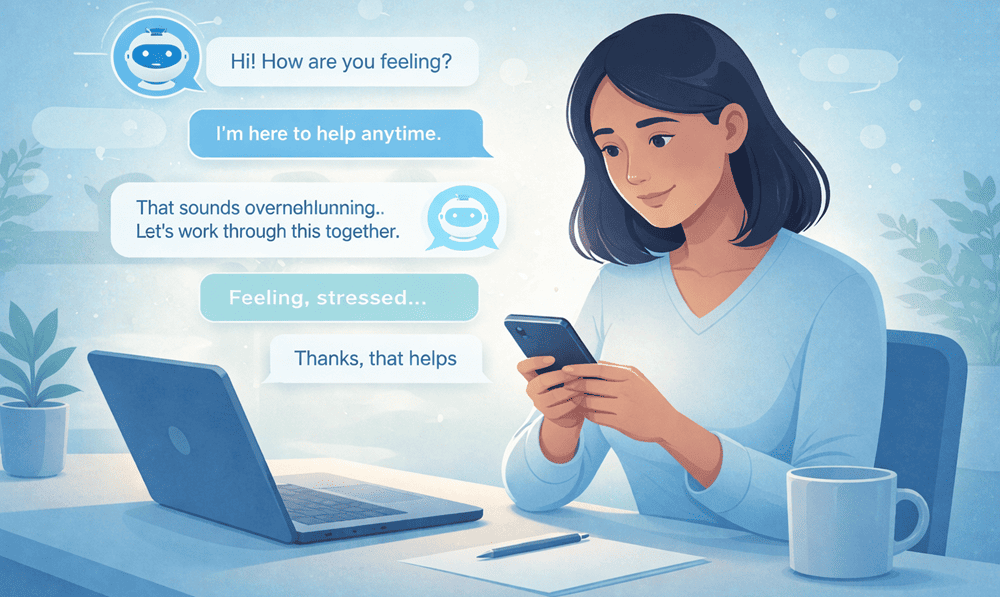
Employee Assistance Programs were designed for a different era of work. They assumed people would reach out during office hours, schedule sessions in advance, and feel comfortable asking for help openly. Today’s workforce doesn’t operate that way.
Employees experience stress late at night, between meetings, during deadlines, and in moments they don’t want to escalate to HR. This is where the AI mental health chatbot is reshaping how organizations deliver emotional support—quietly, continuously, and without friction.
Why Traditional EAPs Fall Short in Modern Workplaces
Most EAPs offer limited availability, long wait times, and low utilization rates. According to industry surveys, fewer than 10% of employees actively use EAP services each year. The issue is not lack of need—it’s access.
Mental strain rarely follows business hours. Anxiety peaks before presentations, after difficult feedback, or during personal crises that don’t fit into appointment slots. AI-based solutions fill this gap by offering conversational support at the exact moment people need it.
What Makes an AI Mental Health Chatbot Different
An AI mental health chatbot does not replace therapists. It acts as a first line of emotional support that listens, responds, and guides users in real time. Employees can interact without scheduling, explaining themselves repeatedly, or worrying about judgment.
Unlike static resources, these systems adapt to tone, language, and context. Over time, they become part of a broader AI for mental health wellbeing strategy that supports employees without overwhelming them.
Always-On Support Without Human Bottlenecks
One of the biggest advantages of AI chatbots is availability. Employees can access guidance at any hour, whether they are working remotely, traveling, or struggling quietly at home.
This constant presence supports on-demand counseling for everyday stressors that may not require clinical escalation but still impact performance and morale. Small moments of support often prevent larger issues from forming.
How Conversational AI Builds Trust Over Time
Employees are more likely to open up when they feel safe. AI chatbots provide a low-pressure environment where people can express concerns without labels or formal processes.
This works especially well when paired with workplace mindfulness practices, such as brief grounding prompts or reflection exercises offered through conversation rather than instruction. The interaction feels personal, not procedural.
The Role of AI CBT in Chatbot-Based Support
Many modern chatbots are trained on principles from cognitive behavioral therapy. They help users recognize thought patterns, question assumptions, and reframe reactions in simple language.
By integrating AI CBT, chatbots can guide users through structured exercises without clinical language or stigma. This makes emotional skill-building accessible to employees who might never attend therapy sessions.
What Employees Actually Use AI Chatbots For
Contrary to assumptions, employees don’t only use chatbots during crises. Most interactions involve everyday challenges tied to work and life balance.
Common use cases include:
- Managing anxiety before meetings
- Processing feedback or conflict
- Handling workload pressure
- Improving sleep routines
- Regaining focus after emotional fatigue
These patterns show how digital therapy tools support daily resilience, not just emergencies.
Data Without Surveillance: A Key Advantage
AI chatbots can identify trends without exposing individuals. Aggregated insights help organizations understand common stress points while maintaining privacy.
When combined with personalized wellness AI, leaders can adjust workloads, communication timing, or support programs based on real behavioral signals rather than assumptions.
This approach builds trust while improving decision-making.
How Chatbots Extend EAP Coverage at Scale
Traditional EAPs rely on limited human capacity. AI chatbots scale instantly across geographies, time zones, and workforce sizes.
They provide:
- Immediate emotional responses
- Consistent guidance quality
- No waiting lists
- No session caps
This makes automated wellbeing guidance practical for organizations with distributed teams or rapid growth.
Where Human Support Still Matters
AI chatbots are not meant to handle severe mental health crises alone. Their role is triage, support, and guidance.
When users show signs of deeper distress, systems can recommend escalation paths within the company’s AI wellness ecosystem, connecting employees to human counselors when appropriate.
This layered approach ensures no one is left unsupported.
Business Impact: Why Leaders Are Adopting AI Chatbots
For business owners and HR leaders, the value is clear. Emotional support improves retention, focus, and engagement.
Organizations using AI chatbots report:
- Lower burnout signals
- Higher EAP engagement
- Faster issue resolution
- Reduced stigma around mental health
These outcomes strengthen broader AI for wellbeing initiatives without adding operational burden.
What a Responsible Implementation Looks Like
Successful rollout depends on transparency. Employees need to understand what data is collected, how it’s used, and where privacy boundaries exist.
Clear communication builds adoption. Positioning the chatbot as support—not monitoring—ensures trust and long-term use.
The Future of Employee Support Is Conversational
Work no longer fits into neat schedules, and emotional strain doesn’t wait for appointments. AI chatbots meet employees where they are—on their terms, in their language, and in real time.
By extending care beyond traditional EAP limits, the AI mental health chatbot becomes more than a tool. It becomes part of the everyday work experience, supporting people quietly while helping organizations build healthier, more resilient teams.