
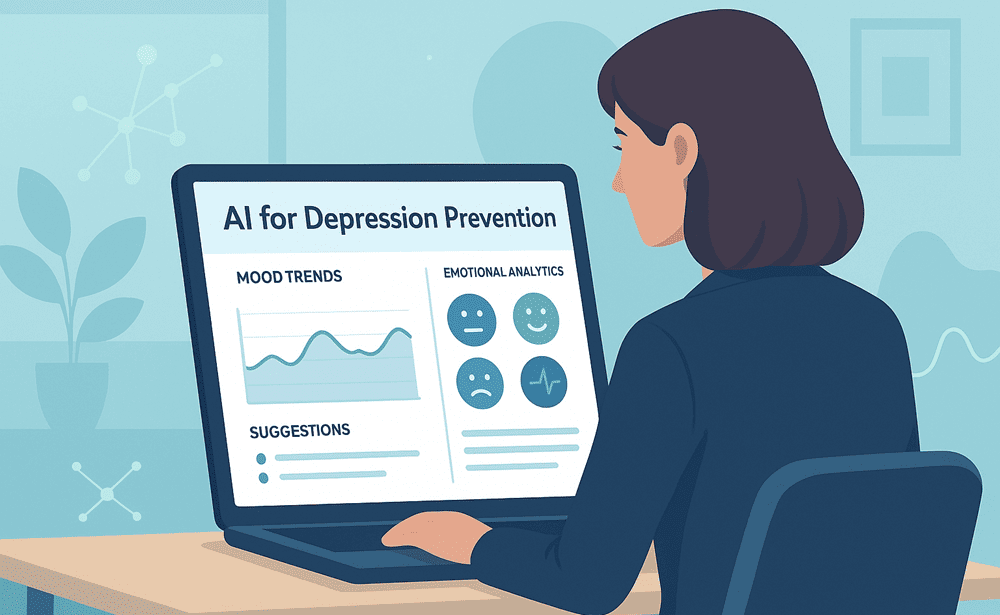
Depression remains one of the leading causes of disability worldwide, affecting millions of employees and eroding productivity, well-being, and quality of life. According to WHO estimates, over 280 million people suffer from depression globally. In corporate settings, untreated depression can lead to absenteeism, decreased engagement, and high turnover.
In this post, we explore how AI for depression prevention is emerging as a proactive tool—one that helps spot early warning signs, deliver tailored support, and reduce risk before full symptom onset. We’ll cover key strategies, real examples, implementation tips, and ethical considerations, all with a practical lens for business leaders.
Why Prevention Matters in Mental Health
- Many people show subtle signs before full-blown depression (sleep disturbance, mood changes, social withdrawal).
- Traditional systems (occasional screening, employee assistance program outreach) often miss those early signs.
- Early intervention tends to yield better outcomes, lower cost, and less disruption.
Thus, layering in technology and preventive mental health technology can help fill gaps. When designed well, such systems can complement but not replace human care.
How AI Enables Depression Prevention
Here are specific mechanisms through which AI tools contribute:
| Strategy | Description | Benefits |
| Predictive risk modeling | AI systems analyze historical data (health records, mood trends, engagement metrics) to estimate future risk | Early flagging of those at higher risk, enabling preventive steps |
| Continuous mood monitoring / AI mood tracking | Tools that passively track mood signals (via wearables, typing patterns, voice, social media) | Better temporal resolution; captures subtle shifts before they escalate |
| Conversational agents / chatbots | Dialogue systems deliver support, prompts, psychoeducation, mood checks | Scalable support 24/7, reduce stigma barrier |
| Adaptive interventions | Based on prediction or mood changes, the system suggests personalized micro-exercises, mindfulness, or check-ins | Tailored prevention, better user engagement |
| Sentiment & behavioral analytics | Analysis of language, communication patterns, sentiment shifts to detect emotional strain | Earlier detection of cognitive or emotional drift |
For example, a recent randomized controlled trial found that an AI-enabled behavioral health platform led to a 34% reduction in depression symptoms, compared to 20% in usual care (TAU).
Another meta-analysis of chatbot interventions showed meaningful reductions in depressive symptoms in adults using AI tools.
Moreover, some AI models now outperform traditional screening questionnaires—for instance, a system leveraging large language models achieved 89% precision versus 72% from the PHQ-9 scale.
These results underscore the power of blending depression prevention AI, predictive AI mental health, and emotion AI in real applications.
Key Components of Effective Prevention Systems
To be useful and safe in a corporate or clinical environment, an AI prevention system should include:
- Data diversity and quality
- Multi-modal inputs (behavioral data, wearable metrics, self-reports)
- Longitudinal data to detect trends
- Multi-modal inputs (behavioral data, wearable metrics, self-reports)
- Explainability and transparency
- Users and clinicians should understand why a risk alert is raised
- Avoid black-box decisions
- Users and clinicians should understand why a risk alert is raised
- Privacy and ethics safeguards
- Strong consent, anonymization, opt-out paths
- Bias testing across demographics
- Strong consent, anonymization, opt-out paths
- Integration with human care
- AI rarely works best alone; it should flag or augment human support
- Hand-off paths to counselors or EAP when needed
- AI rarely works best alone; it should flag or augment human support
- Feedback loops and adaptation
- The system learns from outcomes (who responded, who didn’t)
- Models update as environments or populations change
- The system learns from outcomes (who responded, who didn’t)
- Behavioral design & engagement
- Nudges, micro-tasks, reminders to sustain usage
- Low friction for users
- Nudges, micro-tasks, reminders to sustain usage
A balanced system combining prediction, monitoring, conversational support, and dynamic intervention tends to be the most powerful.
Strategy Roadmap: How to Apply AI for Depression Prevention in Organizations
Here’s a step-by-step approach corporate decision-makers can adopt:
1. Pilot in a small, high-risk group
Start with a group prone to stress (remote teams, frontline staff) to test acceptance, data pipelines, and model performance.
2. Choose a modular architecture
Rather than a monolith, adopt components you can switch in/out: mood tracking module, chatbot module, risk engine, etc.
3. Embed with employee programs
Link AI outputs to HR, wellness programs, manager dashboards, or internal health apps.
4. Monitor performance & outcomes
Track how many alerts translate to actual care, dropouts, false positives, user feedback.
5. Scale cautiously with oversight
Roll out gradually, with proper training, communication, and ethical oversight.
Use Cases & Industry Examples
- A smartphone app using facial cues and AI recognized early signs of depression before users reported symptoms.
- In maternal health, a machine learning tool flagged high risk for postpartum depression to guide preventive outreach.
- The PETRUSHKA algorithm uses AI to personalize antidepressant prescriptions in real time.
- In a trial, generative AI chatbot therapy showed promise in treating depression and anxiety, achieving symptom reduction.
These examples show that AI wellness coach and tools combining AI mood tracking with prediction—are no longer speculative.
Pitfalls, Risks & Mitigations
While promising, AI for depression prevention comes with challenges:
- False positives / negatives: Over-alerting can fatigue users; under-alerting misses risk.
- Privacy concerns & trust: Employees may resist intrusive tracking.
- Bias & inequality: Models trained on narrow populations may not generalize.
- Overreliance on AI: Must remain a support, not a substitute for human care.
- Techno-stress backlash: Paradoxically, overuse of AI systems can increase anxiety if users feel surveilled.
To counter these, organizations should adopt opt-in models, transparency, iterative tuning, human oversight, and ethical review committees.
Success Metrics and KPIs
To measure effectiveness, track:
- Reduction in new clinical depression cases over time
- Changes in self-reported mood, engagement, productivity
- Usage and retention rates of AI tools
- Ratio of alerts leading to human follow-up
- Employee satisfaction, trust, and perception of privacy
- ROI via decreased sick leave, turnover, healthcare costs
Conclusion
AI for depression prevention is no longer futuristic—it is becoming a practical layer in corporate mental health strategy. When deployed thoughtfully, a combination of depression prevention AI, predictive AI mental health, AI mood tracking, and preventive mental health technology can help organizations shift from reactive care to proactive wellness.
By integrating these systems with your human support programs and linking with mental health initiatives, you can support a culture of early care, better outcomes, and stronger resilience.